Integration
Seamless System Integration
Connect systems – unlock greater operational value.
Traditional platforms operate in silos. Our integration framework goes further: unifying access control, tracking, mustering, and third-party systems to deliver a single, consistent data layer and real-time operational insight across your entire environment.
Open, Standards-Based Integration
Seamlessly connect safety, security, and operational systems through a flexible, standards-based framework designed for interoperability at scale.
Secure, API-Driven Architecture
REST-based APIs with authenticated access and encrypted data exchange ensure reliable, secure integration across all connected systems.
Proven Across Complex Environments
Extensively integrated with systems such as PAGA, Fire & Gas, CCTV, ERP, and PTW, delivering reliable performance in safety-critical and industrial operations.
Our Integration Types

Public Address General Alarm (PAGA)
Integration with PAGA systems ensures coordinated emergency communication and automatic system response during critical events.
- Automatic initiation of mustering on alarm activation
- Synchronised audio announcements and visual system status
- Support for multiple alarm types and escalation levels
- Improved clarity and speed of emergency response

Fire & Gas Detection (F&G)
Direct integration with Fire & Gas systems enables immediate, event-driven safety actions across the site.
- Automatic muster triggering on fire or gas detection
- Real-time alarm status shared with safety systems
- Support for zone-based and site-wide alarm scenarios
- Enhanced personnel accountability during incidents

Access Control
Tight integration with access control systems connects personnel movement with safety and operational workflows.
- Accurate tracking of site entry and exit
- Support for automated mustering and POB management
- Unified personnel data across systems
- Consistent enforcement of security and safety policies
- low-threat operational modes

Permit to Work (PTW)
Integration with Permit to Work systems links personnel authorisation with safety controls.
- Verification of permit status during access and mustering
- Improved control of high-risk activities
- Enhanced visibility of active permits during emergencies
- Stronger compliance with safety procedures

Logistics
Integration with logistics systems ensures accurate, real-time Personnel-on-Board (POB) management by synchronising arrivals, departures, and transfers across locations.
- Automatic update of POB based on transport and manifest data
- Synchronisation of helicopter, vessel, or crew movement records
- Reduced manual data entry and administrative overhead
- Improved operational planning and emergency preparedness

Video Surveillance (CCTV)
Integration with video management systems links events and alarms to live and recorded video for enhanced situational awareness.
- Visual verification of access, muster, and alarm events
- Automatic camera call-up on alarms or incidents
- Faster incident assessment and investigation
- Improved coordination between security and safety teams

Third Party Reporting & Dashboards
Open interfaces enable integration with external reporting tools and dashboards for advanced analytics.
- Export of events, alarms, and status data
- Support for business intelligence and visualisation tools
- Custom reporting across multiple systems
- Enhanced operational and management insight

Enterprise Resource Planning (ERP)
Integration with ERP systems ensures alignment between operational systems and business processes.
- Synchronisation of personnel and organisational data
- Reduced manual data entry and administrative effort
- Improved data consistency across platforms
- Support for compliance and reporting requirements

Logistics Integration for Real-Time POB Accuracy
The Challenge
Offshore POB management often relies on manual updates from logistics systems – introducing delays, inconsistencies, and risk. Personnel movements between heliports, vessels, and installations are not always reflected in real time, reducing confidence in POB figures, particularly during emergency situations.
The Solution
Our platform integrates directly with industry logistics systems such as DaWinci, Vantage POB, and Trobexis, automatically synchronising personnel movements between transport and site accountability systems. By connecting logistics and mustering, all arrivals, departures, and transfers are updated in real time – without manual intervention.
At the heliport, personnel are assigned an ePOB tag before departure, digitally linking them to the transport manifest and destination facility. This ensures offshore systems are pre-populated with accurate, up-to-date personnel data before arrival.
How It Works
- Transport manifests are synchronised via secure API integration
- Status updates (boarding, departure, arrival, delays) are automatically transmitted
- POB is updated in real time based on confirmed movements
- Exceptions are flagged for operator review
The Outcome
- Real-time, trusted POB across all locations with reduced administrative workload and human error
- Elimination of manual data entry and reconciliation for faster, smoother crew changes
Key Impact
From the moment personnel check in at the heliport, their movement is digitally tracked and automatically reflected offshore, ensuring accurate POB without reliance on manual processes.
API and Integration Framework
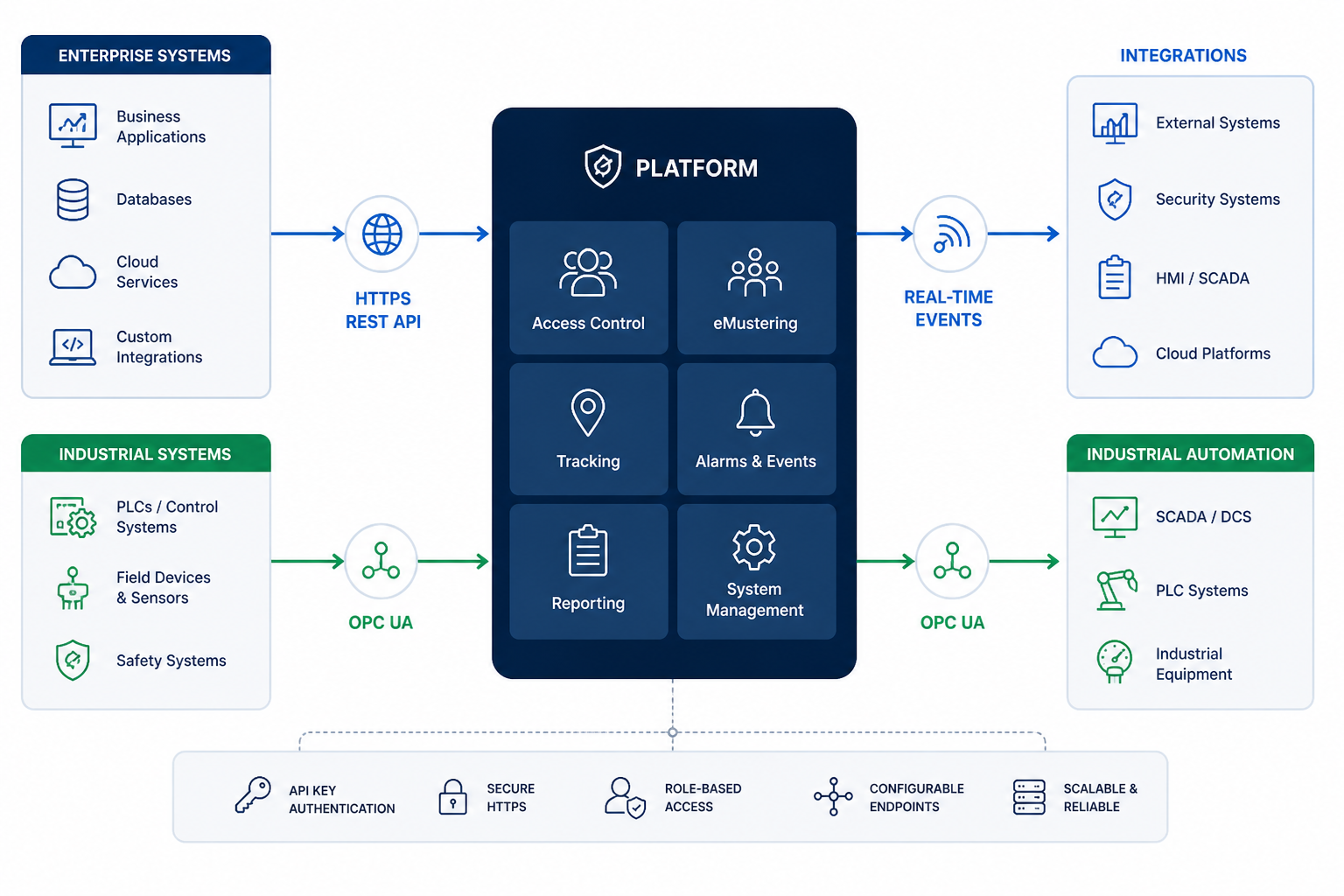
Our platform provides two complementary integration mechanisms, designed to support both enterprise system connectivity and equipment-level data exchange within industrial environments.
For business systems and software applications, a RESTful API enables structured, secure access to platform data and functionality using standard web technologies.
For device and control system integration, the platform supports the OPC UA (Open Platform Communications Unified Architecture) standard, allowing direct interaction with PLCs, industrial control systems, and field equipment.
Together, these interfaces provide a flexible and scalable integration framework, supporting both IT and OT use cases across complex operational environments.
Standards-Based Architecture
The API follows REST principles, using widely adopted web standards to ensure simplicity, compatibility, and maintainability:
- Access via HTTP/HTTPS
- Resource-based endpoint structure
- Support for standard operations (read, update, delete)
- JSON-formatted responses for structured data exchange
Each endpoint represents a discrete system resource—such as personnel, doors, muster points, events, or alarms—allowing integrators to interact with the platform in a logical and predictable way.
Secure by Design
Security is embedded at every layer of the API to ensure controlled and trusted data exchange across all integrations:
- API key–based authentication for all requests
- Unique credentials per application or integration
- Fine-grained access control to system resources and functions
- Encrypted communication (HTTPS) to protect data in transit
This model ensures that only authorised systems can access the platform, while supporting multiple concurrent integrations across a site or enterprise.
Real-Time Event Streaming
In addition to traditional request/response interactions, the platform supports real-time data delivery for time-critical use cases.
Using a persistent connection model, external systems can subscribe to selected event streams and receive updates immediately as changes occur—eliminating the need for continuous polling.
- Low-latency event notifications
- Suitable for alarms, status changes, and live monitoring
- Efficient handling of high-volume event data
- Enables event-driven system behaviour
This capability is particularly valuable for safety, security, and operational systems that depend on immediate awareness and coordinated response.
OPC UA for Industrial Integration
For integration with industrial automation systems, the platform supports OPC UA, a widely adopted standard for secure and reliable machine-to-machine communication.
This enables direct interaction with:
- PLCs and control systems
- Safety and automation infrastructure
- Field devices and sensors
OPC UA is particularly suited to environments where deterministic, system-level communication is required between operational technology components.
Deployment and Configuration
API endpoints are configured on a per-customer basis, aligned with the network architecture and IP addressing of each deployment. This ensures that integrations are tailored to the operational environment while maintaining consistent behaviour across installations.
Proven and Scalable
The API is used internally across all platform modules—including access control, mustering, tracking, and reporting—ensuring it is robust, actively maintained, and production-proven.
The same interfaces are exposed to third parties, providing a stable and well-supported foundation for building and scaling integrations over time.
REST API for Enterprise Integration